The final draft of my first mass is now complete. Many thanks to Giancarlo, Jonathan, and Greg Wait for their input. I suppose this really isn't a final draft as Steve will be giving me some input in a couple days.
I compose and dedicate this Mass #1 to the memory of Erika Knight Fox. Erika, I remember our argument over religion freshman year. I thought I won at the time. I remember you bouncing down the stairs of Madera when we were moving into our dorm the first day of Freshman orientation. Could you be serious wearing those bright orange pants your first day of school? I certainly remember our times talking about life in the hammock. And I will always cherish our time listening to Faure's Requiem as we ate that silly chocolate covered cherry we got at the Stanford Shopping Center.
The Kyrie and Sanctus will be performed on November 18th, 2007 at Stanford Memorial Church by the Stanford Memorial Church Choir and Organist, Robert Morgan.
Kyrie
Gloria I
Gloria II
Credo I
Organ Canon
Credo II & Sanctus
Benedictus
Agnus Dei
Mass No. 1
Monday, September 17, 2007


Saturday, June 23, 2007
Evening in Transylvania: San Jose Chamber Orchestra
I've completed an arrangement of my Bartok variations for the San Jose Chamber Orchestra, who will perform this piece next spring—May 18th I believe. This arrangement calls for a solo trumpet, a solo violin, 11 violins, 4 violas, 4 cellos, and a cello bass. I've included individual movements w/ midi, as well as conductor score and trumpet part.
Evening in Transylvania I: Lento Espressivo
Score
Evening in Transylvania II: Allegro Agitato
Score
Evening in Transylvania III: Scherzando
Score
All movements
Trumpet part
Evening in Transylvania I: Lento Espressivo
Score
Evening in Transylvania II: Allegro Agitato
Score
Evening in Transylvania III: Scherzando
Score
All movements
Trumpet part
Sunday, June 03, 2007
Mass #1: Agnus Dei & Organ Canon
The first draft of my first mass is now complete. I threw away the previous 'Dona' and wrote the new agnus dei movement from scratch. I also have inserted an organ solo in between the two movements of the Credo, and have rewritten the organ introduction to Credo II.
I need to let it sit for a bit, and then come back and fix the broken sections (for example the transition in the Agnus Dei).
Organ Canon
Agnus Dei
I need to let it sit for a bit, and then come back and fix the broken sections (for example the transition in the Agnus Dei).
Organ Canon
Agnus Dei
Monday, May 21, 2007
Mass #1: Credo II & Santus
Work on my first mass continues. I wrote the latest movements while hanging out with my family in Bellagio (Italy, not Vegas). I was inspired not so much by the view but rather by a barking dog. It seems the world, regardless of where you are, will never quite be silent.

Interestingly, the dog barked a minor third but then, every few iterations, it would reach a quarter-tone or so higher suggesting major third. He remained in d-minor (except for the D-major interludes) throughout the vacation, a convenient fact given the structure of the mass (as laid out in the Kyrie) moves from C# phrygian to D and then to E-Major -- so this movement more or less moves to D-minor.
I've combined the 2nd & 3rd movements of the Credo with the Sanctus. With the Benedictus already complete, I'm moving on to the first movement of the Agnus Dei.
Credo II & Sanctus

Interestingly, the dog barked a minor third but then, every few iterations, it would reach a quarter-tone or so higher suggesting major third. He remained in d-minor (except for the D-major interludes) throughout the vacation, a convenient fact given the structure of the mass (as laid out in the Kyrie) moves from C# phrygian to D and then to E-Major -- so this movement more or less moves to D-minor.
I've combined the 2nd & 3rd movements of the Credo with the Sanctus. With the Benedictus already complete, I'm moving on to the first movement of the Agnus Dei.
Credo II & Sanctus
Monday, April 30, 2007
Stanford Memorial Church Choir Chorale No. 4
Greg Wait graciously agreed to perform my chorale #4 on April 22nd.
I've included the revised score of the chorale #4. We found that sustained high Gs for the sopranos was not a good idea. Greg conducted the piece in 4/8 throughout; of course the rhythm is 3:2:3, etc. As always, a few more rehearsals would have helped (including mode switch in bass/tenor @ m 16—b-flat minor). But I thought our choir was exceptional, and I was thrilled to hear this work performed.
In retrospect, I've realized that I remain too harmonic (vertical), and I need to think more about voice leading, as well as allowing more liberties in the hyper meter, as well as phrase alignment with the meter, etc. I'm beginning to believe it not possible to write for choir unless you sing in one and participate in the performance of your own works.
Chorale #4
Chorale #4 final score
I've included the revised score of the chorale #4. We found that sustained high Gs for the sopranos was not a good idea. Greg conducted the piece in 4/8 throughout; of course the rhythm is 3:2:3, etc. As always, a few more rehearsals would have helped (including mode switch in bass/tenor @ m 16—b-flat minor). But I thought our choir was exceptional, and I was thrilled to hear this work performed.
In retrospect, I've realized that I remain too harmonic (vertical), and I need to think more about voice leading, as well as allowing more liberties in the hyper meter, as well as phrase alignment with the meter, etc. I'm beginning to believe it not possible to write for choir unless you sing in one and participate in the performance of your own works.
Chorale #4
Chorale #4 final score
Friday, March 30, 2007
Mass #1: Kyrie
Not many posts recently as I focused most of my time preparing for my piano recital. I neglected to record the recital, but hope to go back and record some of the material. I was happy with the recital (on my 40th birthday, 3/11/2007), particularly my performances of Debussy, Ives, and my own works.
I've started a new project: a mass. I'm not catholic. I was raised LDS in Utah, and currently sing with my wife in Greg Wait's Memorial Church Choir at Stanford. The Memorial Church is non-denominational, but more Christian than otherwise. Greg has decided to perform my Chorale #3/Prelude #4 on April 22nd at the Church. I went back and rewrote this piece when I realized that the voice leading was so choppy—the first time I confronted the fact that I'm a pianist and not a chorist.
Giancarlo sat down with me a couple weeks ago and explained the catholic liturgy, from Christmas through Christmas. I confess the liturgy has little meaning for me. But I respect the tradition, and don't yet feel comfortable with chorale music to push the scope too much.
I've spent a fair amount of time studying a few masses by Palestrina, including a four part Missa Sine Nomine (do - ma re, do re ma fa so le sa...). I'm also looking at Bach's Mass in B minor and Stravinsky's Mass for mixed chorus and double wind quintet. I recently studied Purcell's Dido and Aeneas—I'm becoming more attached to prolonged suspensions and anticipations. The approaches to chromatic harmony in the early baroque seem compelling. Yes, this is all old school. But there is so much to learn and so why not. On the piano, I'm learning some Mendelssohn (op 30 no 5 & 6), and have moved on to the final movement of the Concord Sonata by Ives, Thoreau. I suppose whatever you are studying sinks in and ultimately influences what you write, not to mention other music you know.
I built the Kyrie largely on Phrygian C#, but freely move around, including C# minor etc. My goal was to use imitation throughout, with a defined but interrupted progression that never completes the phyrigian cadence until the final bar.
On the topic of old vs new, a few weeks ago I attended a lecture by the composer Christian Wolff. I found Mr. Wolff to be both brilliant & kind. I enjoyed the talk very much. I asked him why he, Cowell, & Cage found it so important to turn their back on the past and strive for the new unique sound. He said he wasn't sure, but it seemed important at the time. I believe him. But I wonder whether this compositional ethos ('must create the new sound'), which represents an important period of music and which I refer to as experimentalism, no longer drives the mainstream of new compositional thought.
For me, the challenge with experimentalism isn't so much the art and ethos, but rather our ability to comprehend this music. It has become so utterly detached from the 'human' side of the equation. Ironically, with the desire to not-conform, the experimentalists' collective and uniform extreme reaction to tradition has created the greatest period of conformity in music since Palestrina. So, perhaps a better term than experimentalist would be reactionist: as a group they are one.
I don't insist tonality must return as a musical language. But I accept that tonality worked -- we could comprehend. Give me something new and different, yet let me comprehend it -- allow my brain, with reasonable training, to pattern match. Moreover, let me want to listen again to learn more. I don't buy the arguments that we are so brainwashed by tonality that we can't possibly comprehend the new, the unique. We are products of our history and we simply can't ignore this. Tonality developed and evolved over several centuries. It wasn't an accident. Two of my favorite composers, Debussy and Ives, believed that in future generations children would whistle semi-tones, etc. It has not yet happened -- in fact, children today have less musical training, less 'sophisticated' ears than past generations.
Let me quote from a disciple of the famous musicologist Schenker, Felix Salzer, from his Structural Hearing, Chapter 1, pg 7:
"It is equally imperative that we be at all times receptive and responsive to the new, and I think we are now on the whole more open-minded than other periods have been. However, the tendency which we often observe to discuss modern compositions in vague generalities is not only unjust to contemporary composers, but is very detrimental to our attempts to meet the crisis. In the appraisal of new works, just as in the analysis of older compositions, there is an unfortunate tendency to be satisfied with vague categorizations according to such superficial stylistic criteria as "new-classic,", "neo-romatic," "linear," etc., or to describe their outer, visible appearance, so to speak, in terms of external aesthetic values. These terms, while having a definite place in the field of music criticism, hardly ever touch upon the actual musical utterance. Often terms such as "original," or "bold" or "interesting" are profusely used but do not succeed in covering up what is lacking either in the music itself or in the listener's understanding.
"Furthermore, it seems as though some musicians are so deadly afraid of "missing" a talent that they think it safer to praise most new compositions, thus demonstrating an appalling lack of judgment and discrimination. This curious attitude has indeed become a veritable obsession with all too many musicians, critics and teachers. Whether we are prejudiced and condemn or neglect works simply because they are new and sound unusual or for other narrow-minded reasons, or whether we go to the other extreme and lose our sense of judgment merely because the work is new and we are afraid to be blamed for not having recognized a talent—both attitudes seem to me equally detrimental to the development of music. Either will delay more than promote the process of finding a definite language of musical expression."
While I deeply respect Schenker and Salzer's work, I don't believe music can so readily be explained with a single model, etc. I do find Salzer's above argument, however, not only to be compelling but also as relevant today as when he wrote it fifty years ago. It isn't to say that the experimental period of music was not necessary and or not important. I can't look at images of 1917 and 1945 without a profound desire to react to whatever culture created these abominations. I recently attended a concert where Anthony de Mare performed John Cage's The Wonderful Widow of Eighteen Springs (1942), Nowth upon Nacht (1984), A Room (1943), Tossed as It Is Untroubled (1943) as well as Henry Cowell's The Banshee (1925) and Advertisement (1914) among other works. "A Room" was neither neo-classical, nor neo-romantic, nor linear. The texture and timbre which this piece creates on the piano are more than unique, in fact they are beautiful.
My four nocturnes were a reaction to the 'new art'; they were an attempt to embrace intrinsic human desires such as singing, dancing, pro-creating. Perhaps I don't grasp the artistic movements of our generation and I don't belong. Our existence seems so transient, hardened by technology, and alienated by the very mobility we seem to cherish so much. The proliferation of connectivity and information has created a wide-scale crisis of identity, and a resultant desire to demonstrate the unique. A humanistic (yes I've abused the definition here a bit) movement in music, by contrast, would represent the very anti-thesis of these trends. A humanistic movement would perhaps be the appropriate response to the post-modern era.
It seems appropriate, therefore, that music be allowed, once again, to look forward and backward, and most of all to be human. My three-year-old daughter loves to sing and dance. She is not the victim of brainwashing. She is human, all too human.
And so, in order to embrace the future I return to my study of the past. I will write a Mass. I don't care whether I create a new sound, defy the past, or embrace the past. I simply want to write a chorale work that includes the organ.
Kyrie
I've started a new project: a mass. I'm not catholic. I was raised LDS in Utah, and currently sing with my wife in Greg Wait's Memorial Church Choir at Stanford. The Memorial Church is non-denominational, but more Christian than otherwise. Greg has decided to perform my Chorale #3/Prelude #4 on April 22nd at the Church. I went back and rewrote this piece when I realized that the voice leading was so choppy—the first time I confronted the fact that I'm a pianist and not a chorist.
Giancarlo sat down with me a couple weeks ago and explained the catholic liturgy, from Christmas through Christmas. I confess the liturgy has little meaning for me. But I respect the tradition, and don't yet feel comfortable with chorale music to push the scope too much.
I've spent a fair amount of time studying a few masses by Palestrina, including a four part Missa Sine Nomine (do - ma re, do re ma fa so le sa...). I'm also looking at Bach's Mass in B minor and Stravinsky's Mass for mixed chorus and double wind quintet. I recently studied Purcell's Dido and Aeneas—I'm becoming more attached to prolonged suspensions and anticipations. The approaches to chromatic harmony in the early baroque seem compelling. Yes, this is all old school. But there is so much to learn and so why not. On the piano, I'm learning some Mendelssohn (op 30 no 5 & 6), and have moved on to the final movement of the Concord Sonata by Ives, Thoreau. I suppose whatever you are studying sinks in and ultimately influences what you write, not to mention other music you know.
I built the Kyrie largely on Phrygian C#, but freely move around, including C# minor etc. My goal was to use imitation throughout, with a defined but interrupted progression that never completes the phyrigian cadence until the final bar.
On the topic of old vs new, a few weeks ago I attended a lecture by the composer Christian Wolff. I found Mr. Wolff to be both brilliant & kind. I enjoyed the talk very much. I asked him why he, Cowell, & Cage found it so important to turn their back on the past and strive for the new unique sound. He said he wasn't sure, but it seemed important at the time. I believe him. But I wonder whether this compositional ethos ('must create the new sound'), which represents an important period of music and which I refer to as experimentalism, no longer drives the mainstream of new compositional thought.
For me, the challenge with experimentalism isn't so much the art and ethos, but rather our ability to comprehend this music. It has become so utterly detached from the 'human' side of the equation. Ironically, with the desire to not-conform, the experimentalists' collective and uniform extreme reaction to tradition has created the greatest period of conformity in music since Palestrina. So, perhaps a better term than experimentalist would be reactionist: as a group they are one.
I don't insist tonality must return as a musical language. But I accept that tonality worked -- we could comprehend. Give me something new and different, yet let me comprehend it -- allow my brain, with reasonable training, to pattern match. Moreover, let me want to listen again to learn more. I don't buy the arguments that we are so brainwashed by tonality that we can't possibly comprehend the new, the unique. We are products of our history and we simply can't ignore this. Tonality developed and evolved over several centuries. It wasn't an accident. Two of my favorite composers, Debussy and Ives, believed that in future generations children would whistle semi-tones, etc. It has not yet happened -- in fact, children today have less musical training, less 'sophisticated' ears than past generations.
Let me quote from a disciple of the famous musicologist Schenker, Felix Salzer, from his Structural Hearing, Chapter 1, pg 7:
"It is equally imperative that we be at all times receptive and responsive to the new, and I think we are now on the whole more open-minded than other periods have been. However, the tendency which we often observe to discuss modern compositions in vague generalities is not only unjust to contemporary composers, but is very detrimental to our attempts to meet the crisis. In the appraisal of new works, just as in the analysis of older compositions, there is an unfortunate tendency to be satisfied with vague categorizations according to such superficial stylistic criteria as "new-classic,", "neo-romatic," "linear," etc., or to describe their outer, visible appearance, so to speak, in terms of external aesthetic values. These terms, while having a definite place in the field of music criticism, hardly ever touch upon the actual musical utterance. Often terms such as "original," or "bold" or "interesting" are profusely used but do not succeed in covering up what is lacking either in the music itself or in the listener's understanding.
"Furthermore, it seems as though some musicians are so deadly afraid of "missing" a talent that they think it safer to praise most new compositions, thus demonstrating an appalling lack of judgment and discrimination. This curious attitude has indeed become a veritable obsession with all too many musicians, critics and teachers. Whether we are prejudiced and condemn or neglect works simply because they are new and sound unusual or for other narrow-minded reasons, or whether we go to the other extreme and lose our sense of judgment merely because the work is new and we are afraid to be blamed for not having recognized a talent—both attitudes seem to me equally detrimental to the development of music. Either will delay more than promote the process of finding a definite language of musical expression."
While I deeply respect Schenker and Salzer's work, I don't believe music can so readily be explained with a single model, etc. I do find Salzer's above argument, however, not only to be compelling but also as relevant today as when he wrote it fifty years ago. It isn't to say that the experimental period of music was not necessary and or not important. I can't look at images of 1917 and 1945 without a profound desire to react to whatever culture created these abominations. I recently attended a concert where Anthony de Mare performed John Cage's The Wonderful Widow of Eighteen Springs (1942), Nowth upon Nacht (1984), A Room (1943), Tossed as It Is Untroubled (1943) as well as Henry Cowell's The Banshee (1925) and Advertisement (1914) among other works. "A Room" was neither neo-classical, nor neo-romantic, nor linear. The texture and timbre which this piece creates on the piano are more than unique, in fact they are beautiful.
My four nocturnes were a reaction to the 'new art'; they were an attempt to embrace intrinsic human desires such as singing, dancing, pro-creating. Perhaps I don't grasp the artistic movements of our generation and I don't belong. Our existence seems so transient, hardened by technology, and alienated by the very mobility we seem to cherish so much. The proliferation of connectivity and information has created a wide-scale crisis of identity, and a resultant desire to demonstrate the unique. A humanistic (yes I've abused the definition here a bit) movement in music, by contrast, would represent the very anti-thesis of these trends. A humanistic movement would perhaps be the appropriate response to the post-modern era.
It seems appropriate, therefore, that music be allowed, once again, to look forward and backward, and most of all to be human. My three-year-old daughter loves to sing and dance. She is not the victim of brainwashing. She is human, all too human.
And so, in order to embrace the future I return to my study of the past. I will write a Mass. I don't care whether I create a new sound, defy the past, or embrace the past. I simply want to write a chorale work that includes the organ.
Kyrie
Friday, February 09, 2007
Schumann Fantasy in C Op 17
I finished a paper on Schumann's Fantasy in C. I'll be performing this piece at my recital, which strangely enough I've scheduled for the afternoon of March 11, forty years after the day of my birth.
I don't think I could have written this paper without having studied the piece in a performance capacity for the past year or so. I also don't think the insight would have been nearly as developed if not for the support of my advisor,Dr. Berger. The book by Nicholas Marston was extremely valuable, as was the biography of Schumann by Daverio.
I intend to record all three movements of the Fantasy over the coming weeks. Ultimately, my interpretation of the piece will be more representative of my views on the work rather than this paper.
Earth's Many Colored Dream: Schumann Fantasy in C Op 17
Briefly, I propose a new model of perceptual analysis to suggest that in fact an intuitive structure and form exists in the first movement.
I don't think I could have written this paper without having studied the piece in a performance capacity for the past year or so. I also don't think the insight would have been nearly as developed if not for the support of my advisor,Dr. Berger. The book by Nicholas Marston was extremely valuable, as was the biography of Schumann by Daverio.
I intend to record all three movements of the Fantasy over the coming weeks. Ultimately, my interpretation of the piece will be more representative of my views on the work rather than this paper.
Earth's Many Colored Dream: Schumann Fantasy in C Op 17
Briefly, I propose a new model of perceptual analysis to suggest that in fact an intuitive structure and form exists in the first movement.
Chorale #4
I've finished setting the text for Chorale #4.
I wrote the chorale a year ago after my grandmother Evelyn visited memchu to attend service and hear us sing. We sang All Creatures that morning. To remember this day and her, I came home that afternoon and wrote this piece. Unfortunately she passed away a few months later; my mother played this chorale at her funeral.
While I've written a lot since this time, and my style has evolved to perhaps challenge tonality moreso, I still enjoy the simple pieces. Technically this is my fourth prelude, but my third chorale, so the name is a little misleading.
When I set the text to this piece (and I advise all to start with text not music!), I of course took the original St. Francis text "The Canticle of Brother Sun". I find he emphasizes Lord throughout, not to offend our modern people, but rather to perhaps offset his praise of 'sister earth, moon, brother sun, etc.'.
I couldn't help but think of Vera during the final stanzas, and so decided to expand the dedication to include her.
Modulations and rhythm require some care, but I think the voice leading is largely straightforward.
Greg Wait has offered to have our memorial church choir sing this work in a future performance.
Score
Stanford Memorial Church Choir
I wrote the chorale a year ago after my grandmother Evelyn visited memchu to attend service and hear us sing. We sang All Creatures that morning. To remember this day and her, I came home that afternoon and wrote this piece. Unfortunately she passed away a few months later; my mother played this chorale at her funeral.
While I've written a lot since this time, and my style has evolved to perhaps challenge tonality moreso, I still enjoy the simple pieces. Technically this is my fourth prelude, but my third chorale, so the name is a little misleading.
When I set the text to this piece (and I advise all to start with text not music!), I of course took the original St. Francis text "The Canticle of Brother Sun". I find he emphasizes Lord throughout, not to offend our modern people, but rather to perhaps offset his praise of 'sister earth, moon, brother sun, etc.'.
I couldn't help but think of Vera during the final stanzas, and so decided to expand the dedication to include her.
Modulations and rhythm require some care, but I think the voice leading is largely straightforward.
Greg Wait has offered to have our memorial church choir sing this work in a future performance.
Score
Stanford Memorial Church Choir
Sunday, December 17, 2006
Evening in Transylvania III
I've completed the 'final' movement of my Bartok song cycle/octet/piano duet. This little nugget, I believe, complements and closes the cycle.
The form of the three movements should now be clear with this final addition. Besides Bartok's theme from his Easy Piano Piece, An Evening in Transylvania, the movement includes an obvious allusion to Shostakovich (quartet #8).
Evening in Transylvania, Scherzo and Lento (Sibelius)
Octet Score
The form of the three movements should now be clear with this final addition. Besides Bartok's theme from his Easy Piano Piece, An Evening in Transylvania, the movement includes an obvious allusion to Shostakovich (quartet #8).
Evening in Transylvania, Scherzo and Lento (Sibelius)
Octet Score
Monday, December 04, 2006
Evening in Transylvania II
Well, these aren't really preludes any more, but rather a set of movements from my new song cycle, which really isn't a song cycle as it is currently arranged for a chamber group of flute, clarinet in b-flat, trumpet in c, two violins, a viola, and a cello -- make that two cellos. I'm still building out the variations on Bartok's easy piano piece "Evening in Transylvania".
This work also uses some polytonality. The harmonic progression of Bartok's work is developed on the beat in the high strings, and on the double bar in the low strings. The high strings offer the progression in thirds, then (with some periodic help) in triadic form. The high strings and winds/trumpet move between c minor and g minor as they offer up the progression.
Evening in Transylvania, Allegro Agitato (Sibelius)
Score
Here is a piano arrangement for four hands, one piano:
Piano Primo
Piano Secondo
This work also uses some polytonality. The harmonic progression of Bartok's work is developed on the beat in the high strings, and on the double bar in the low strings. The high strings offer the progression in thirds, then (with some periodic help) in triadic form. The high strings and winds/trumpet move between c minor and g minor as they offer up the progression.
Evening in Transylvania, Allegro Agitato (Sibelius)
Score
Here is a piano arrangement for four hands, one piano:
Piano Primo
Piano Secondo
Wednesday, November 29, 2006
Evening in Transylvania I
Bela Bartok wrote 10 Easy Pieces for piano. "Evening in Transylvania" comes from this set, #6 I believe. We listened to a Bartok recording of this piece in Dr. Barth's master class.
My previous piano teacher, Mr. Adolph "Ushu" Baller, knew Bartok. I think he and Yehudi hung out with Bartok in New York in the early 40's, after Mr. Baller escaped Austria (via Budapest and Turkey), and prior to Mr. Baller and his wife Edith moving to the bay area. I wish I could talk more with Mr. Baller about Bela. And I regret not studying more of Bartok's music with Mr. Baller. I remember Mr. Baller once told me that he knew two words in Hungarian: "I do".
I want to set this to a song cycle. Here is the first attempt, but in chamber form following the previous prelude #14 with flute, clarinet in b-flat, trumpet in C, two violins, viola, and one cello. I have several ideas for expansion here, but need to button up this iteration for classes tomorrow. The piece is yet another experiment in polytonality.
Evening in Transylvania, first movement (Sibelius)
Score
My previous piano teacher, Mr. Adolph "Ushu" Baller, knew Bartok. I think he and Yehudi hung out with Bartok in New York in the early 40's, after Mr. Baller escaped Austria (via Budapest and Turkey), and prior to Mr. Baller and his wife Edith moving to the bay area. I wish I could talk more with Mr. Baller about Bela. And I regret not studying more of Bartok's music with Mr. Baller. I remember Mr. Baller once told me that he knew two words in Hungarian: "I do".
I want to set this to a song cycle. Here is the first attempt, but in chamber form following the previous prelude #14 with flute, clarinet in b-flat, trumpet in C, two violins, viola, and one cello. I have several ideas for expansion here, but need to button up this iteration for classes tomorrow. The piece is yet another experiment in polytonality.
Evening in Transylvania, first movement (Sibelius)
Score
Wednesday, November 08, 2006
Prelude #14
Still working on this one, an assignment for Giancarlo, which is due tomorrow. I remain focused on church modes and counterpoint. This prelude is phrygian. G.C. dictated a subject for the exercise.
I listen to the piece now and it sounds like the E minor (tonic) is in fact the dominant. Perhaps this is simply my tonal ear training. Or perhaps the sustained pedal tone on E creates the tension around E, and you want to resolve to A. One of the reasons I like the church modes is the ambiguity they create around a tonal center.
I'm completely swamped this week as I'm teaching CS202 @ Stanford tomorrow evening, and then leading a presentation in Jonathan Berger's seminar on the Schumann Fantasy. Of course I have voice and piano lessons tomorrow as well, in addition to choir practice in the evening. Hmn...
Coming back to the piece. Giancarlo and I have spent some time reviewing this piece. He offered a number of suggestions. I've taken another cut and believe the changes are positive.
Prelude #14
Prelude #14 Score
I'm starting to work on a new song cycle, influenced by Bartok. Hopefully I'll find some time to develop the piece over the next few days...
I listen to the piece now and it sounds like the E minor (tonic) is in fact the dominant. Perhaps this is simply my tonal ear training. Or perhaps the sustained pedal tone on E creates the tension around E, and you want to resolve to A. One of the reasons I like the church modes is the ambiguity they create around a tonal center.
I'm completely swamped this week as I'm teaching CS202 @ Stanford tomorrow evening, and then leading a presentation in Jonathan Berger's seminar on the Schumann Fantasy. Of course I have voice and piano lessons tomorrow as well, in addition to choir practice in the evening. Hmn...
Coming back to the piece. Giancarlo and I have spent some time reviewing this piece. He offered a number of suggestions. I've taken another cut and believe the changes are positive.
Prelude #14
Prelude #14 Score
I'm starting to work on a new song cycle, influenced by Bartok. Hopefully I'll find some time to develop the piece over the next few days...
Tuesday, October 31, 2006
Chorale #2
I've returned to the study of counterpoint. I've spent some time with Giancarlo Aquilanti looking at Palestrina and church modes. I'm tempted to transcribe several of Palestrina's chorales for piano and perform them. Here is an excerpt of the
Kyrie from his Missa Brevis.
Sometimes I wonder what the world would be like without Bach. I suppose it's wrong to give him credit for the tonal language that defined classical music for the next couple hundred years. But if one were to identify the Dante of tonality, Bach would certainly be a likely choice. Without Bach, or perhaps without the clear definition of the tonal language, is it possible the polyphony of Palestrina would have evolved differently?
It's almost easier for me to make the jump to polytonality from polyphony than from tonality. With polyphony and church modes, you don't have the strong cadences that typically define a tonal center. And hence you have the opportunity to create more ambiguity, more nuance. I wonder whether composers such as Stravinsky and Ives attempted to build the bridge back to Palestrina and polyphony. My initial work on the Inferno cycle reflects my own desire to explore models of polytonality.
I recall the stories of how often Robert Schumann would go back to the Well Tempered Clavier to study counterpoint. Certainly an understanding of counterpoint and motion in music is as relevant today as centuries before. Motion seems fundamental to music, and without an understanding of dissonance and counterpoint, I wonder whether true motion is possible. I would like, therefore, to spend more time learning about counterpoint, and I want to understand the polyphony of Palestrina.
At any rate, my Chorale #2 is nothing so grand, but rather a simple exercise in counterpoint and church modes. I find the piece sounds slightly modern—I don't always prepare the dissonance (fourths, seconds, sevenths) for example. I had a lot of fun developing the subject.
Chorale #2 score
Chorale #2 original score
Sometimes I wonder what the world would be like without Bach. I suppose it's wrong to give him credit for the tonal language that defined classical music for the next couple hundred years. But if one were to identify the Dante of tonality, Bach would certainly be a likely choice. Without Bach, or perhaps without the clear definition of the tonal language, is it possible the polyphony of Palestrina would have evolved differently?
It's almost easier for me to make the jump to polytonality from polyphony than from tonality. With polyphony and church modes, you don't have the strong cadences that typically define a tonal center. And hence you have the opportunity to create more ambiguity, more nuance. I wonder whether composers such as Stravinsky and Ives attempted to build the bridge back to Palestrina and polyphony. My initial work on the Inferno cycle reflects my own desire to explore models of polytonality.
I recall the stories of how often Robert Schumann would go back to the Well Tempered Clavier to study counterpoint. Certainly an understanding of counterpoint and motion in music is as relevant today as centuries before. Motion seems fundamental to music, and without an understanding of dissonance and counterpoint, I wonder whether true motion is possible. I would like, therefore, to spend more time learning about counterpoint, and I want to understand the polyphony of Palestrina.
At any rate, my Chorale #2 is nothing so grand, but rather a simple exercise in counterpoint and church modes. I find the piece sounds slightly modern—I don't always prepare the dissonance (fourths, seconds, sevenths) for example. I had a lot of fun developing the subject.
Chorale #2 score
Chorale #2 original score
Tuesday, October 10, 2006
Inferno IV: Moderato
I'm attempting to build out the cycle of Inferno, modeling images to text from the first several Canto's of Dante's Inferno. When I originally wrote this particular movement a few months ago, it didn't not belong to any cycles and so I, by default, grouped it with the nocturnes. I was attempting to express some of the darker images I have of man's existence when writing the piece, and so feel comfortable adjusting the work and now including it with some of the other works from my Inferno cycle. I was obviously influenced by the composer I quote in bars 92-95, and don't necessarily cherish the proposed answer (?) provided here.
Regarding the composition, I worked on two concepts for the piece. One concept was to maintain two seperate tonal centers with associated seperate meters that eventually converge. Another idea was to develop a modified triadic progression maintained in minor until a cadence. I realize I push the horns, but am interested in that strained sound, and believe it will work.
Inferno IV: Moderato (Cubase)
Inferno IV score
Dante's Divine ComedyInferno, Canto IV, 1:12
Copyright © Princeton Dante Project
A heavy thunderclap broke my deep sleep
so that I started up like one
shaken awake by force.
With rested eyes, I stood
and looked about me, then fixed my gaze
to make out where I was.
I found myself upon the brink
of an abyss of suffering
filled with the roar of endless woe.
It was full of vapor, dark and deep.
Straining my eyes toward the bottom,
I could see nothing.
Regarding the composition, I worked on two concepts for the piece. One concept was to maintain two seperate tonal centers with associated seperate meters that eventually converge. Another idea was to develop a modified triadic progression maintained in minor until a cadence. I realize I push the horns, but am interested in that strained sound, and believe it will work.
Inferno IV: Moderato (Cubase)
Inferno IV score
Dante's Divine ComedyInferno, Canto IV, 1:12
Copyright © Princeton Dante Project
A heavy thunderclap broke my deep sleep
so that I started up like one
shaken awake by force.
With rested eyes, I stood
and looked about me, then fixed my gaze
to make out where I was.
I found myself upon the brink
of an abyss of suffering
filled with the roar of endless woe.
It was full of vapor, dark and deep.
Straining my eyes toward the bottom,
I could see nothing.
Thursday, October 05, 2006
Prelude #5
I've finally set Prelude #5, a chorale prelude, to text. I knew when writing this music what text I wanted to use including several of the key passages, but I wrote the music first and set the text second. I'm not sure, in retrospect, this is optimal. But it produced an interesting piece, a piece that has a lot of meaning for me.
Prelude #5 updated
Prelude #5 Score for Choir
I guess I'm discovering a spiritual side of sorts -- spiritual as opposed to religious that is. Having grown up in Utah, I've come to accept that spirituality is part of who I am. On the other hand, I haven't concluded whether I'm agnostic or athiest, perhaps agnostic as I don't want to suggest that I have an agenda to convince others of a belief system, and lack any confidence to suggest otherwise. I certainly respect religion and appreciate the lessons it offers life. But I also fear religion, and the power it seems to offer man over man. I've never liked arbitrary power, and I've often witnessed the abuse of such power to subjugate or even exploit people. Yet I can't seem to suppress deeply spiritual feelings I have, humbly offered forth in this chorale. I dedicate the chorale to my mother. I hope it offers her some peace.
Prelude #5 updated
Prelude #5 Score for Choir
I guess I'm discovering a spiritual side of sorts -- spiritual as opposed to religious that is. Having grown up in Utah, I've come to accept that spirituality is part of who I am. On the other hand, I haven't concluded whether I'm agnostic or athiest, perhaps agnostic as I don't want to suggest that I have an agenda to convince others of a belief system, and lack any confidence to suggest otherwise. I certainly respect religion and appreciate the lessons it offers life. But I also fear religion, and the power it seems to offer man over man. I've never liked arbitrary power, and I've often witnessed the abuse of such power to subjugate or even exploit people. Yet I can't seem to suppress deeply spiritual feelings I have, humbly offered forth in this chorale. I dedicate the chorale to my mother. I hope it offers her some peace.
Thursday, September 07, 2006
Opus 7: Inferno III: nè allegro nè lento
I've written a first draft to another movement of an orchestral work composed to text from Dante's Inferno. It remains in draft form and is incomplete. I continue working on the first movement as well. Sadly, I report I also continue working on Purgatorio, in particular the Femmina Balba works. So much to do, so little time, and two young children...
Inferno III: nè allegro nè lento (Cubase)
Inferno III score
I've attached the Original sketch as a reference.
Dante's Divine Comedy
Inferno, Canto III, 34:69
And he to me: 'This miserable state is borne
by the wretched souls of those who lived
without disgrace yet without praise.
'They intermingle with that wicked band
of angels, not rebellious and not faithful
to God, who held themselves apart.
'Loath to impair its beauty, Heaven casts them out,
and depth of Hell does not receive them
lest on their account the evil angels gloat.'
And I: 'Master, what is so grievous to them,
that they lament so bitterly?'
He replied: 'I can tell you in few words.
'They have no hope of death,
and their blind life is so abject
that they are envious of every other lot.
'The world does not permit report of them.
Mercy and justice hold them in contempt.
Let us not speak of them -- look and pass by.'
And I, all eyes, saw a whirling banner
that ran so fast it seemed as though
it never could find rest.
Behind it came so long a file of people
that I could not believe
death had undone so many.
After I recognized a few of these,
I saw and knew the shade of him
who, through cowardice, made the great refusal.
At once with certainty I understood
this was that worthless crew
hateful alike to God and to His foes.
These wretches, who never were alive,
were naked and beset
by stinging flies and wasps
that made their faces stream with blood,
which, mingled with their tears,
was gathered at their feet by loathsome worms.
The structure of the piece more or less attempts to follow a braided rope. I've tried to construct an harmonic model for this piece, derived from standard tonal theory but using a system of diatonic inversions. The idea is to create a four part harmony and complement that harmony with an inverted four part harmony in a related key. The inversions wrap around the initial harmony to form the structure of the rope. The inversions and the original harmony move to related keys, different registers, and/or timbres to facilitate the braided structure.
I define a diatonic inversion as follows:
I -> VIII (I)
ii -> vii
iii -> vi
IV -> V
V -> IV
etc.
Some special cases:
N (flatted II) -> vii
ii diminished -> VII
ii minor -> vii diminished
etc.
Again, the attempt is a diatonic inversion (versus a more precise twelve-tone inversion).
For the sake of these examples, consider a simple base progression as follows:
I V/iii VI/iii iii V I
I use three diatonic inversions in this piece, defined below:
parallel inversion
I V/vi VI/vi vi IV I
So, the notion of a secondary dominant is preserved, but it applies instead to the inversion of iii, or vi.
single inversion
I IV/iii iii/iii iii V I
double inversion
I IV/vi VI/vi vi IV I
For example, if I use the simple base progression above (I V/iii ...) in C major, I map the inverted harmony (parallel or single or double) to d minor. Noting the overtone technique in Inferno: Andante Agitato, I keep the inverted harmony (usually) a couple registers above the base harmony. The first few bars of the piece actually begin in these keys; the progression is slightly more sophisticated. In subsequent bars, the base harmony moves to e minor, and I introduce a second inversion on D, etc.
I know I'm really pushing the violist in this piece, but God knows they don't get enough interesting work compared to the violins. And I want a strained sound in the upper registers, which is why the viola may reach above the violins. I maintain some elements from the first movement, including a simple, resigned vocal line with more complex harmonic movement in strings & brass.
Inferno III: nè allegro nè lento (Cubase)
Inferno III score
I've attached the Original sketch as a reference.
Dante's Divine Comedy
Inferno, Canto III, 34:69
And he to me: 'This miserable state is borne
by the wretched souls of those who lived
without disgrace yet without praise.
'They intermingle with that wicked band
of angels, not rebellious and not faithful
to God, who held themselves apart.
'Loath to impair its beauty, Heaven casts them out,
and depth of Hell does not receive them
lest on their account the evil angels gloat.'
And I: 'Master, what is so grievous to them,
that they lament so bitterly?'
He replied: 'I can tell you in few words.
'They have no hope of death,
and their blind life is so abject
that they are envious of every other lot.
'The world does not permit report of them.
Mercy and justice hold them in contempt.
Let us not speak of them -- look and pass by.'
And I, all eyes, saw a whirling banner
that ran so fast it seemed as though
it never could find rest.
Behind it came so long a file of people
that I could not believe
death had undone so many.
After I recognized a few of these,
I saw and knew the shade of him
who, through cowardice, made the great refusal.
At once with certainty I understood
this was that worthless crew
hateful alike to God and to His foes.
These wretches, who never were alive,
were naked and beset
by stinging flies and wasps
that made their faces stream with blood,
which, mingled with their tears,
was gathered at their feet by loathsome worms.
The structure of the piece more or less attempts to follow a braided rope. I've tried to construct an harmonic model for this piece, derived from standard tonal theory but using a system of diatonic inversions. The idea is to create a four part harmony and complement that harmony with an inverted four part harmony in a related key. The inversions wrap around the initial harmony to form the structure of the rope. The inversions and the original harmony move to related keys, different registers, and/or timbres to facilitate the braided structure.
I define a diatonic inversion as follows:
I -> VIII (I)
ii -> vii
iii -> vi
IV -> V
V -> IV
etc.
Some special cases:
N (flatted II) -> vii
ii diminished -> VII
ii minor -> vii diminished
etc.
Again, the attempt is a diatonic inversion (versus a more precise twelve-tone inversion).
For the sake of these examples, consider a simple base progression as follows:
I V/iii VI/iii iii V I
I use three diatonic inversions in this piece, defined below:
parallel inversion
I V/vi VI/vi vi IV I
So, the notion of a secondary dominant is preserved, but it applies instead to the inversion of iii, or vi.
single inversion
I IV/iii iii/iii iii V I
double inversion
I IV/vi VI/vi vi IV I
For example, if I use the simple base progression above (I V/iii ...) in C major, I map the inverted harmony (parallel or single or double) to d minor. Noting the overtone technique in Inferno: Andante Agitato, I keep the inverted harmony (usually) a couple registers above the base harmony. The first few bars of the piece actually begin in these keys; the progression is slightly more sophisticated. In subsequent bars, the base harmony moves to e minor, and I introduce a second inversion on D, etc.
I know I'm really pushing the violist in this piece, but God knows they don't get enough interesting work compared to the violins. And I want a strained sound in the upper registers, which is why the viola may reach above the violins. I maintain some elements from the first movement, including a simple, resigned vocal line with more complex harmonic movement in strings & brass.
Monday, August 28, 2006
Robert Schumann
I've been on this Schumann thing for a while. I never tire of his chamber works. While driving to Wyoming with the family, I had the St. Lawrence String Quartet recording of his first and third quartets in the car. I couldn’t stop listening to it. Hopefully this link to the second movement works: Schumann Quartet #1 Second Movement. You can buy the disk on Amazon.
While working on his Fantasy Op 17, I read a biography by John Daverio, "Robert Schumann: Herald of a New Poetic Age". (Apparently Daverio, like Schumann, also threw himself in a river -- the Charles? -- but, unlike Schumann unfortunately, actually succeeded). I found the biography to be persuasive. I confess that I broke down in tears when I read of Robert’s final days in the asylum, how Clara finally managed to visit him shortly before he passed away, and how apparently he recognized her. No need to recap the book here, but I was struck by the creative, literary dimension of this composer. All his life, it seems, he considered himself as much a poet as a composer. Certainly his lieder bring poetry to a new level, combining text with the color and nuance of tone.
I enjoy the fresh ideas Schumann brings to his music. For example, in his Op 17 Fantasy in C, the first movement "Ruins" (I guess this title didn't survive) starts with a dominant bass line (G) and a broken chord, likely a dominant 11th or a combined dominant + subdominant. You really don't get the tonic (C) in root position until the final few bars of the piece. And it ain't a short piece! As far as form, the developed theme is suggested only in fragments and finally stitched together, again, in the final few bars. When the full theme is finally stated (from Beethoven's An die ferne Geliebte, Op.98), you wonder where you have heard it before as it sounds vaguely familiar. The piece dates from the early 19th century (1838/9).
I wonder whether Robert wrote his Hausmusic to pay the bills. I guess his Album for the Young, written for his children (Robert and Clara had seven), was one of his top sellers. His fantasy was not; apparently even Clara stopped performing it on her tours after only a year or so. I previously believed that his Kinderszenen, like the Album für die Jugend, were also written for children. Certainly they are more straightforward than other keyboard works of his. Yet, according to Daverio, it was not intended for children per se, but rather was Robert's attempt to capture scenes from his own childhood.
I took a cut tonight at recording the first piece of the Kinderszenen Op 15, Schumann: Kinderszenen: Von fremden Ländern und Menschen. It's a straightforward read, but when you climb into the score you realize there are subtle choices. Consider a few examples:
While working on his Fantasy Op 17, I read a biography by John Daverio, "Robert Schumann: Herald of a New Poetic Age". (Apparently Daverio, like Schumann, also threw himself in a river -- the Charles? -- but, unlike Schumann unfortunately, actually succeeded). I found the biography to be persuasive. I confess that I broke down in tears when I read of Robert’s final days in the asylum, how Clara finally managed to visit him shortly before he passed away, and how apparently he recognized her. No need to recap the book here, but I was struck by the creative, literary dimension of this composer. All his life, it seems, he considered himself as much a poet as a composer. Certainly his lieder bring poetry to a new level, combining text with the color and nuance of tone.
I enjoy the fresh ideas Schumann brings to his music. For example, in his Op 17 Fantasy in C, the first movement "Ruins" (I guess this title didn't survive) starts with a dominant bass line (G) and a broken chord, likely a dominant 11th or a combined dominant + subdominant. You really don't get the tonic (C) in root position until the final few bars of the piece. And it ain't a short piece! As far as form, the developed theme is suggested only in fragments and finally stitched together, again, in the final few bars. When the full theme is finally stated (from Beethoven's An die ferne Geliebte, Op.98), you wonder where you have heard it before as it sounds vaguely familiar. The piece dates from the early 19th century (1838/9).
I wonder whether Robert wrote his Hausmusic to pay the bills. I guess his Album for the Young, written for his children (Robert and Clara had seven), was one of his top sellers. His fantasy was not; apparently even Clara stopped performing it on her tours after only a year or so. I previously believed that his Kinderszenen, like the Album für die Jugend, were also written for children. Certainly they are more straightforward than other keyboard works of his. Yet, according to Daverio, it was not intended for children per se, but rather was Robert's attempt to capture scenes from his own childhood.
I took a cut tonight at recording the first piece of the Kinderszenen Op 15, Schumann: Kinderszenen: Von fremden Ländern und Menschen. It's a straightforward read, but when you climb into the score you realize there are subtle choices. Consider a few examples:
- What is the tempo? Schumann gives 108mm per quarter, but several editors suggest that in the neo-romantic style, 80mm per quarter would be more accurate. I tried both and like both, but prefer the slower tempo. (I had the same question with the 66m per quarter in the third movement of his fantasy. Apparently Clara's edition had 66mm per dotted quarter; I find her tempo too fast. Here, I think the 66mm per quarter is accurate.)
- He ties the G in bar 6 -- the first time he holds the tenor voice. Why? Perhaps this is the first time he doesn't skip the subdominant, and he wants to hear the melodic shift. The tie seems to help maintain the longer phrase.
- Notice the rests in the bass when the A theme is first stated, but then the sustained tones when B theme is stated, suggesting a duet between soprano and bass voices in B but not A.
- It's easy to over-voice this piece. I tried to ease off my voicing on the soprano (melody).
- What to do on the repeat? I use a different dynamic for A -- Baller usually liked that.
- Notice the fermata in the last bar of B, but not at the end of the bar. How do you handle the final notes of this phrase after the fermata? I chose to expand a ritard. but not the same duration as the fermata.
- I don't consider the final note of this bar an up beat to the next phrase.
Anyway, you get the idea -- perhaps there is never just a straightforward read.
Sunday, August 27, 2006
More Recordings
I sat down this afternoon and recorded a few more of my preludes, plus some Bach and Ravel. It's not perfect, but I'm out of gas at this point. I listen to this stuff and realize that I remain an amateur. For example, I rush the Courante -- if I could only take more time. Tone control is getting better, but I'm still far from where I'd like to be.
Prelude #10
Prelude #11
Prelude #12
Ravel: A la Maniere de Borodine
Bach: French Suite #4: Allemande
Bach: French Suite #4: Courante
Bach: French Suite #4: Sarabande
Bach: French Suite #4: Gavotte
Bach: French Suite #4: Menuet
Bach: French Suite #4: Air
Where is the Gigue, you may ask? I need a few more days on this piece. The ornaments don't sound right at tempo...
Did you realize that each piece in the suite is a baroque dance? According to G. Henle Verlag's Urtext, the Allemande is a German processional dance in 4/4 time. The Courante was originally a French ball-room dance but now under Italian influence is graceful but extremely serious in rhythm. The Sarabande is a Spanish dance with grave melody and emphasis on the second beat. The Menuet -- a favorite French dance of the period, named for the small steps it used. Etc.
I find it strange that most contemporary classical music has little to do with singing and dancing (unless you call Broadway classical!) It almost seems like music is becoming more ethereal over time.
Prelude #10
Prelude #11
Prelude #12
Ravel: A la Maniere de Borodine
Bach: French Suite #4: Allemande
Bach: French Suite #4: Courante
Bach: French Suite #4: Sarabande
Bach: French Suite #4: Gavotte
Bach: French Suite #4: Menuet
Bach: French Suite #4: Air
Where is the Gigue, you may ask? I need a few more days on this piece. The ornaments don't sound right at tempo...
Did you realize that each piece in the suite is a baroque dance? According to G. Henle Verlag's Urtext, the Allemande is a German processional dance in 4/4 time. The Courante was originally a French ball-room dance but now under Italian influence is graceful but extremely serious in rhythm. The Sarabande is a Spanish dance with grave melody and emphasis on the second beat. The Menuet -- a favorite French dance of the period, named for the small steps it used. Etc.
I find it strange that most contemporary classical music has little to do with singing and dancing (unless you call Broadway classical!) It almost seems like music is becoming more ethereal over time.
Friday, August 25, 2006
Orchestration
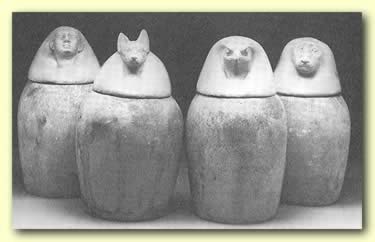
I'm working with Jin-Dong Cai to learn more about orchestration and conducting. One of our first exercises was to orchestrate a piano piece. I chose Debussy's Canope from his second book of preludes. I believe Debussy had two ancient Egyptian canopic jars on his desk, the story goes.
I looked at this piece with George Barth and made the argument (convincing or not) that the structure was built on a pentatonic key which defines the melodic line in the opening. The harmonic progression follows this line throughout, moving more or less up and down by fifth.
Here I include an mp3/midi (Cubase) of the orchestration version, as well as my full orchestration score.
Debussy's Canope: Prelude #10, Book II
Orchestration Score of Canope
Piano Performance
Charles Ives: Concord Sonata, "The Alcotts"
It was a real treat to work on this piece with Dr. George Barth. John Kirkpatrick's score for the Alcotts was invaluable. You might visit Yale's online archive of Ives.
Prelude #1
Prelude #3
Prelude #6
Prelude #8
It was a real treat to work on this piece with Dr. George Barth. John Kirkpatrick's score for the Alcotts was invaluable. You might visit Yale's online archive of Ives.
Prelude #1
Prelude #3
Prelude #6
Prelude #8
Subscribe to:
Posts (Atom)